A site for the moment after watching
reescoopstoryjlt.buzz is an independent, informative website about television storylines and endings. It is for viewers who have finished an episode or series and want to work out how the pieces fit: the sequence of events, the decisions behind them and the unanswered questions that remain.
The central distinction is simple. What an ending shows is one layer; what viewers infer is another. Both deserve attention, but putting them in the same sentence without a label can make an explanation more certain than its evidence allows.
Four reading routes
- Recaps: reconstruct the causal route and separate event order from reveal order.
- Endings: identify what the finale resolves mechanically, emotionally and morally.
- Characters: compare stated motives with decisions, alternatives and costs.
- Theories: test competing readings against both supporting details and counterexamples.
These routes overlap at the level of the story, but each asks a different question. A recap should not quietly become a prediction. A character study should not reduce someone to a diagnosis. A theory should not erase an explicit scene because a different ending would feel more satisfying.
How evidence is described
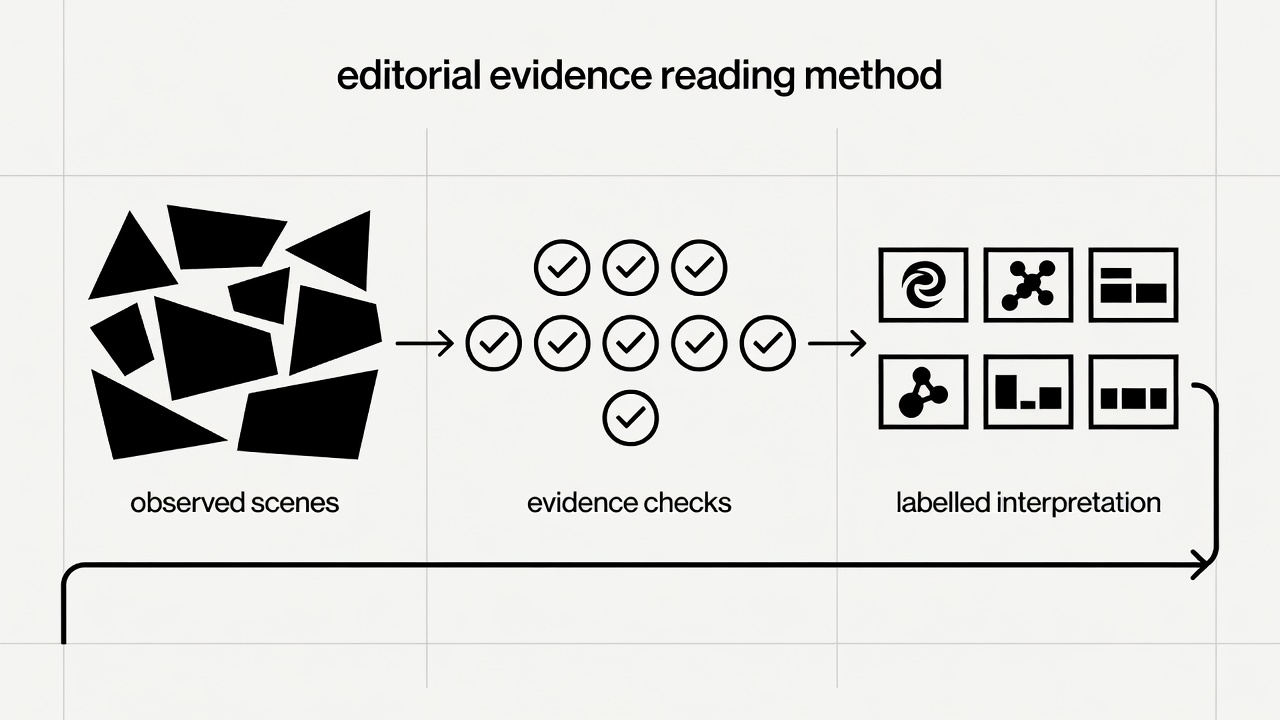
Observable events are described directly. Supported interpretations use language such as “suggests,” “can be read as” or “supports.” Possibilities that require additional assumptions are identified as speculative. This keeps confidence visible without making every sentence tentative.
Episode titles, season positions and complete-series counts are stable identifiers, not live viewing data. Reference links provide background checks and are marked when the destination may reveal more than the current page. A reference page is not a substitute for the scene being analysed, and an interview is not silently treated as dialogue within the programme.
No affiliate links, discounts or paid viewing recommendations are included. The website does not claim privileged access to creators or represent a programme’s official explanation.
Spoiler boundaries are part of the explanation
Closed panels identify a work and a scope without stating the twist. Opening a panel is a deliberate move into that analysis. A first-season recap does not borrow a later finale to make an early scene easier to explain. When a whole series is required, that requirement is announced first.
The illustrations are conceptual narrative diagrams, not screenshots or replicas of official programme artwork. They organise the reading rather than assert new facts about a fictional world.